
Dorset, UK | 26 October 2026
Wheeler Bio has shared results from its collaboration with TEK Optima Research showing that imaging data collected during clonality assessment can help predict how CHO clones will perform later in fed-batch bioreactor culture.
Using the DeepInsight® platform, the team converted routine bright-field well image series into detailed clone growth profiles. These profiles were used alongside early titre data to assess whether early clonal outgrowth could predict later production performance.
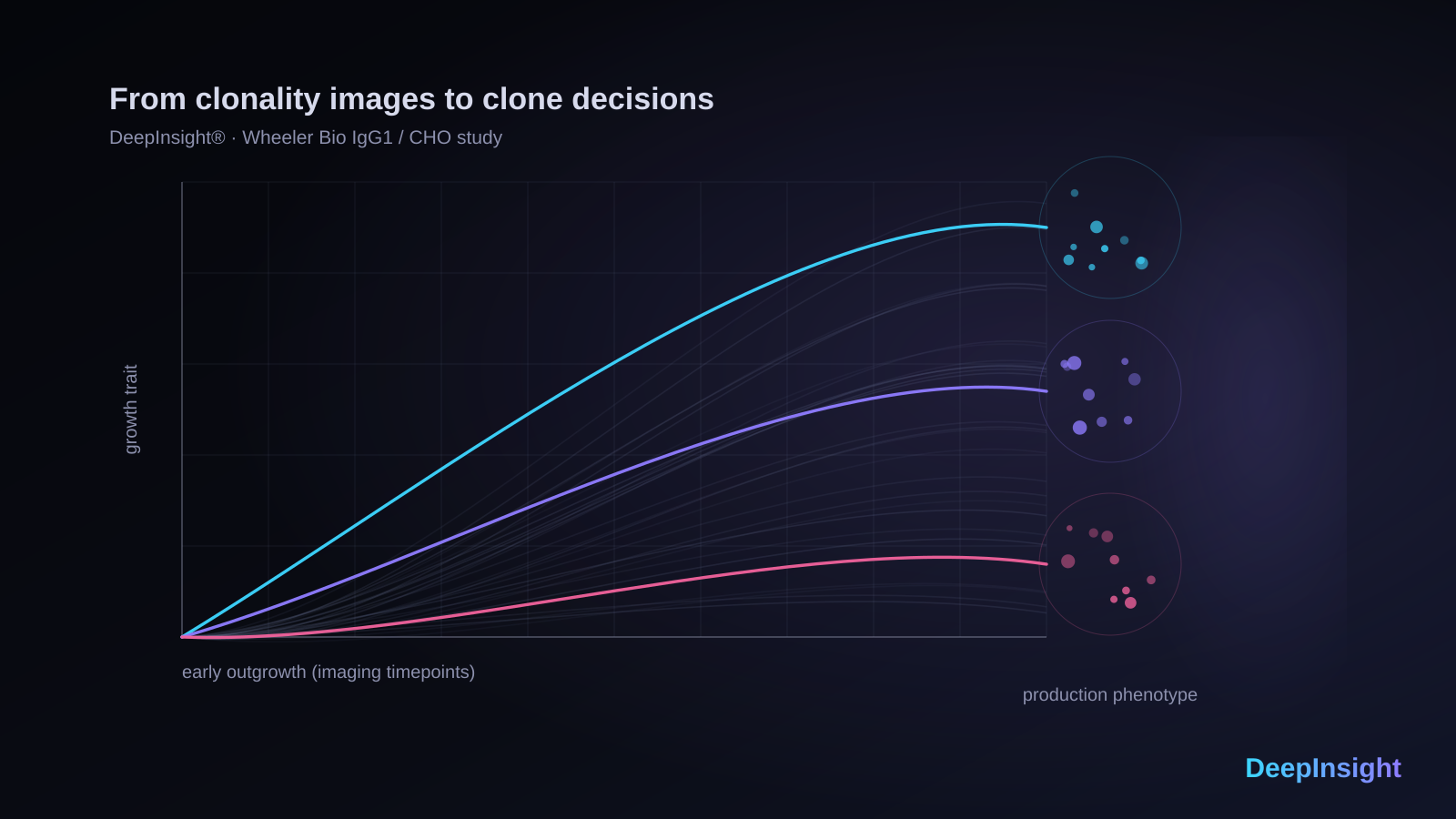
The study identified three distinct production phenotypes. Early clone behaviour was shown to provide useful indication of the type of producer a clone would become in fed-batch culture.
The findings were presented at BioProcess International in September 2026. Wheeler Bio has since published news from the work, together with a video of the presentation, on its website: Smarter Clone Selection: Earlier, more informed decisions for novel biologics.
A better-informed clone selection decision
Selecting the right clone is one of the most important decisions in cell line development.
A stable, high-producing clone provides a stronger foundation for process development and manufacturing. Conversely, selecting a clone that later proves unsuitable can lead to costly repeat work, delays and avoidable risk as a programme moves forward.
The overall CLD workflow is familiar. A stable pool is generated, individual cells are isolated and documented for clonality, and clones are expanded through well plates before a smaller group progresses to fed-batch screening.
At the point of down-selection, decisions are often based on limited endpoint measurements, typically a titre assay and confluence measurement at the end of well-plate growth. These are useful measures, but they provide only a partial view of how a clone has developed over time and may not reflect later fed-batch performance.
Meanwhile, imaging systems already collect a substantial amount of data during single-cell isolation and clone outgrowth. In many workflows, that data is used primarily to document clonality.
The Wheeler Bio study examined whether those existing images, analysed using DeepInsight, could provide detailed clone growth profiles that help predict fed-batch outcomes earlier in the process.
The study
Wheeler Bio worked with TEK Optima Research to analyse image series from clones expressing a single IgG1 monoclonal antibody in one CHO lineage.
DeepInsight was used to extract quantitative traits from early clonal outgrowth and build detailed growth profiles from the image data. These image-derived measurements were combined with titre data collected during outgrowth to create composite scores.
The scores were then tested against fed-batch outcomes in clones that had not been used to build the model. This was designed to assess predictive performance, rather than simply identify correlations in the original dataset.
The analysis showed that clones separated into three statistically distinct production phenotypes. A clone's early outgrowth profile was associated with the type of producer it later became in fed-batch culture.
Importantly, the best later producers were not always the clones that would have been selected using endpoint confluence and titre measurements alone.
What this means for CLD teams
DeepInsight enables teams to make more use of imaging data already generated during routine clonality and outgrowth workflows.
Rather than relying on a single endpoint view of well-plate growth and titre, teams can use the full history of clone development captured in their image series. This provides a more detailed picture of clone behaviour before committing resources to fed-batch work.
In practice, this could help CLD teams to:
- Identify non-producing or low-potential clones earlier, reducing unnecessary titre-assay screening
- Retain more clones with strong predicted production potential
- Focus fed-batch capacity on better-informed candidates
- Assess clone behaviour earlier without introducing new assays, hardware or changes to established imaging workflows
- Support down-selection using more than a single titre ranking or endpoint confluence measurement
The result is a more informed route into fed-batch screening, with resources focused on clones that are more likely to perform well in production.
Next steps
This study showed that early image-derived clone growth profiles can be used to identify meaningful production phenotypes.
DeepInsight is continuing to extend the richness of information extracted from routine imaging data. This includes more detailed analysis of how clones grow over time, how colonies develop internally, and how early growth behaviour can be linked to later process performance.
The aim is straightforward: to give CLD teams a fuller and earlier understanding of clone behaviour from data they are already collecting.
We will share further work as it develops. To discuss evaluating early clone performance using your own imaging data, contact press@tekor.tech.
About TEK Optima Research
TEK Optima Research develops AI-powered analytics for biopharmaceutical development.
Its DeepInsight® platform converts existing brightfield microplate images into detailed cell and colony measurements, growth profiles and clone rankings. The platform works with existing imaging workflows and does not require new hardware, stains or additional wet-lab assays.
TEK Optima Research trains and develops bespoke neural networks for biopharmaceutical imaging applications. The company is based in Dorset, UK, and operates purpose-built infrastructure for isolated customer data processing.
For more information, visit deepinsight.bio or contact press@tekor.tech.
About Wheeler Bio
Wheeler Bio is a contract development and manufacturing organisation focused on the development and manufacture of antibody-based therapeutics. Its ModularCMC™ platform supports the translation of programmes from discovery into clinical studies.
Media contact
Brad Turner
Founder and CTO
TEK Optima Research Ltd
Email: press@tekor.tech
Web: deepinsight.bio